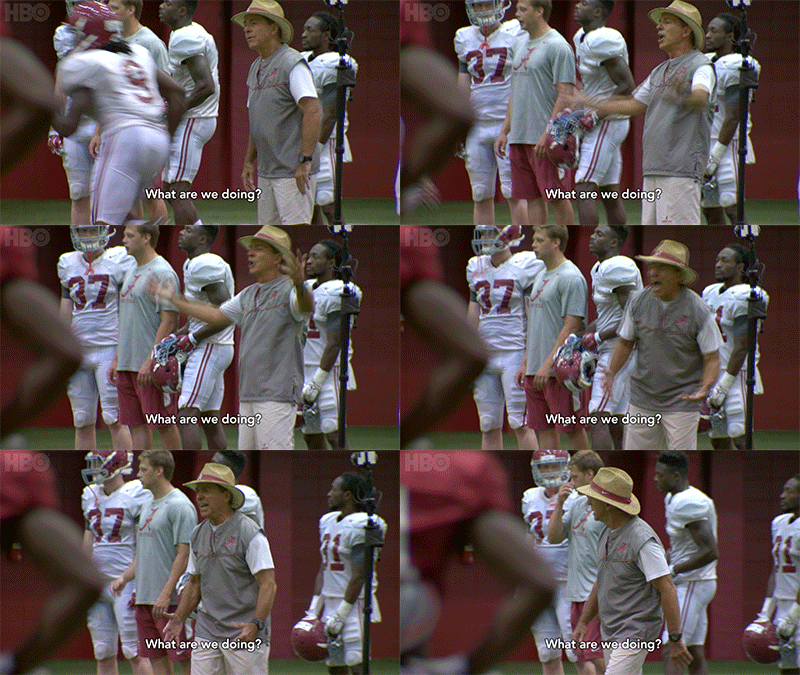
I got three essentials, and a bunch of extras.
My experience doesn’t come from coaching football teams despite the GIF. I coach professionals in the workplace to help them reach their full potential and keep a healthy well-being on the job. Which clearly distinguishes me from a mentor, whose primary role is still to teach, advise, and share the expertise.
I personally jumped into it without really knowing what to expect from the role and from myself, at times without even understanding the very rationale behind coaching. And this, although I had been a coachee myself for some time, encouraged by my employer. Was this sceptical attitude the typical reaction of somebody who feels she doesn’t need to be fixed, so what the hell? What a misunderstanding. Perhaps it was. What I can surely tell you a few years later is that it’s worth it even if it takes time to appreciate.
While figuring out myself as a coach, these were the first things I observed in my journey as the very fundamentals.
Rule number one. You are here to ask.
Self explanatory yet difficult to do. Among other reasons because we all have an opinion, and we want to let it out. We might also have an expertise; we want to be free to impart it, too. But these are not the reasons you’re here. Your goal is not to figure out a solution for the coachee and present her with it. Rather you’re here to ask as many questions as you can – think “laddering” – in order, first, to understand the issue, and, second, to guide the coachee through her thinking to the answer. Which might as well be a next step or even a better understanding of the situation for a start.
Rule number two. You are here to listen.
Listen more than you speak. Let the coachee shine, in a way let her do the work. Take it as a job interview: you’re the interviewer, she’s the interviewee. The rule is rather simple, no other than to speak as little as you can, to go back to rule number one by asking as much as you can, and to avoid statements for the sake of sharing an opinion. Even when you mirror her words or challenge the ambiguity, this is not the time to give a long speech.
Rule number three. You have a role, and this role is not to be a friend.
Your role here is to be a coach, and you simply need to keep it to that during the session. Even if you feel you really like the person across you, you absolutely get her, you totally empathise, you are actual friends, you still need to ask, challenge, push, and pull. A pat on the shoulder is sweet, but it’s not coaching.
Four. Pair your role with some relevant training.
You might or might not have the chance to attend a number of trainings and theory classes upon beginning to coach. Whatever your situation is, do spend some time on formally educating yourself on the role, and start early. Pairing theory and practice will not only develop you faster and more effectively but also differentiate you as a true professional in the field.
Five. Try peer coaching.
I found this surprisingly helpful. Every coach has different coaching style, different coachees, is essentially a different coach in case you hadn’t noticed. But coaching remains a fairly defined activity, and so exchanging on different cases, scenarios, successful techniques, or flops will open a whole new world of insights you couldn’t even tell existed. Why do I find this type of exchange absolutely relevant for coaches? Given that the work of a coach usually takes place behind closed doors and in confidentiality, it can be difficult to draw learnings from sources other than a rigid training or your very personal practice. Your peers are here to fill this gap.
Six. It’s okay to go slow.
I love this statement. It literally fits anywhere – hashtag-prom-night. Back to coaching, though, you don’t need to start complicated. I know that those visualization techniques seem exciting, employing a flip chart makes the whole experience look very important, and the last training you joined gave you 17 new options how to coach. You’ll soon realize that certain things in coaching come (or go?) with the flow. There will be a time when using pen and paper or that framework with the German name will come naturally. It will surely depend on your level of confidence as a professional as well as on the person you have in front of you.
Seven. Care about the chemistry.
Sometimes, it just doesn’t work. You might need to find a different coachee, she might need to find a different coach. These relationships do thrive on trust and other soft notions. Ergo part of acting professionally is to have the courage and transparency to admit that this match wasn’t a match. You want to be useful, she wants to get something out of this.
Any coaches out there? What were your first learnings in the role?
Image via HBO on GIPHY.
 I walk fast.